Neuro

ARP Neuro Therapy

Electrical stimulation that retrains how your muscles fire, so you rebuild around an injury instead of working around it.

Locations
ARP Neuro Therapy at Rehab Lab

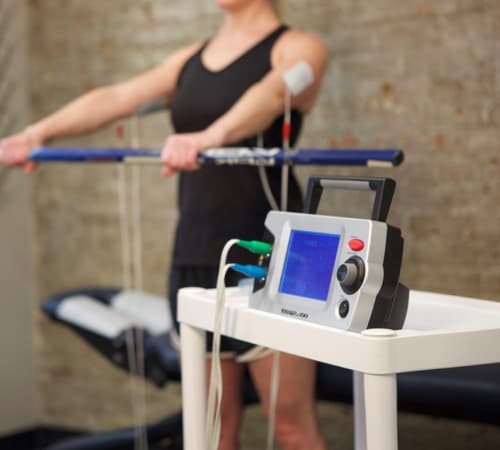
ARP neuro therapy uses a specific type of electrical stimulation to reach the nervous system, not just the muscle. After an injury your body often learns to avoid using a muscle properly, it shuts it down to protect you. ARP helps re-establish that connection so the muscle fires fully again while you move.

We use it to rebuild strength and control around a weak link, a quad that will not wake up after knee trouble, a glute that stopped contributing, the deep stabilizers that went quiet after a back injury.

Treating the wiring, not just the muscle

Most rehab tools work on the muscle itself. ARP works on the signal that tells the muscle when and how hard to fire. When that signal is off, you can train all day and still feel like the muscle is not pulling its weight, because it literally is not.

By stimulating the nervous system while you perform movements, we retrain the firing pattern. That makes the corrective exercise we build on top of it far more effective.

Where it fits

  • Rebuilding strength after a sports injury or surgery
  • Waking up muscles that shut down after a back or knee problem
  • Breaking through plateaus where strength has stalled
  • Improving control and recovery for serious athletes
Good to know

ARP Neuro Therapy questions

Is ARP just like a TENS unit?

No. A TENS unit masks pain by distracting the nerves. ARP uses a different waveform aimed at improving how your muscles contract while you move, so it builds function rather than just covering symptoms.

Will it be uncomfortable?

You feel a strong contraction sensation, but we control the intensity with you the whole time. It should feel productive, not painful.

What does ARP therapy feel like?

An intense but tolerable electrical sensation, usually described as a strong buzzing or pulling, while you move the limb or hold a position. It works hardest at the exact point where your body is protecting itself, which is why the intensity is part of the treatment rather than a side effect.

Why is ARP used while I am moving rather than lying still?

Because the point is to retrain how the muscle fires during actual movement, not to pass current through resting tissue. Combining the stimulus with a movement you are struggling to produce is what changes the pattern. A machine applied while you lie passively is a fundamentally different treatment.

What conditions is ARP most useful for?

Cases where a muscle will not switch on properly, which is common after an injury or a surgery: a quadriceps that will not fire after a knee problem, a glute that stopped contributing, chronic protective guarding that has outlasted the original injury. It is less useful for simple acute stiffness.

How many ARP sessions before I notice something?

Many people feel a difference in how a muscle engages within the first session or two, because the change is neurological rather than structural. Holding that change takes repetition, so we pair it with corrective exercise and typically run a course over a few weeks.

Who should not have ARP therapy?

We avoid it with a pacemaker or implanted electrical device, during pregnancy, over an active cancer site, and over areas with no sensation. Tell us your full history and medications at the first visit and we will route you to something appropriate instead.

Ready to fix the cause, for good?

Book at our Wauwatosa or Appleton clinic and get a real plan from a doctor who treats you like a teammate.

Locations

Wauwatosa · Appleton · No referral needed