
The pain is real and it is in your knee, usually at the front, around or under the kneecap, and worst on stairs, hills, and the first mile. The cause is usually somewhere else. Runner’s knee is a load problem, and that load is generally being mismanaged by the hip above it, the ankle below it, or a training week that climbed faster than the tissue could adapt. That is why resting it works for a couple of weeks and then stops working.
What runner’s knee actually is
Runner’s knee is the common name for patellofemoral pain, which describes irritation where the kneecap meets the thigh bone. The kneecap glides in a groove as the knee bends and straightens, and it is built to handle enormous compressive force while doing it. Problems start when that force gets concentrated unevenly, or delivered more often than the joint has been prepared for.
Notice what that description does not include: damage. Most patellofemoral pain is not a torn structure or a worn-out joint. It is a well-built joint being asked to absorb load it is not currently equipped for. That is good news, because load tolerance is trainable and structural damage is not.
The three places it usually starts
The hip
The knee is at the mercy of the hip. If the muscles on the outside of the hip are not controlling the thigh bone, the knee drifts inward every time you land, and the kneecap is dragged across its groove rather than along it. You can often see it from behind: a knee that collapses toward the midline on a single-leg squat or at the moment of landing. The knee is where it hurts. The hip is where the control is missing.
The ankle
A stiff ankle sends the problem upward. If the ankle cannot bend far enough for the shin to travel forward over the foot, something has to give, and it is usually the knee absorbing more of the shock while the arch collapses to buy the missing range. An old sprain you stopped thinking about years ago is a common source of that stiffness.
The training week
Sometimes the mechanics are fine and the arithmetic is not. A jump in weekly mileage, a new hill route, a switch to faster running, or a return after time off will all outrun the tissue’s ability to adapt. Tendon and cartilage adapt more slowly than the cardiovascular system, which is the cruel part of the sport: your lungs are ready for the mileage weeks before your knees are.
Why rest keeps failing
Rest works, and that is the trap. Two weeks off and the pain settles, because you removed the load that was irritating the joint. Nothing about the hip control, the ankle range, or the training pattern changed, so when you return at the volume that caused it, it returns on roughly the same schedule.
The second lap of that cycle is usually worse, because two weeks off also costs you strength. You come back slightly weaker to the same demand. People who have been round this loop three or four times often conclude their knees are simply bad. Almost always it is the loop that is bad.
What actually resolves it
- Find the real limiter. Hip control, ankle range, or training load, and frequently two of the three at once. Treating the knee alone is what makes this recur.
- Keep training, modified. Complete rest is rarely necessary. Cutting volume, flattening the route, and shortening your stride are usually enough to settle symptoms while the cause gets fixed.
- Load the knee deliberately. The joint needs strength work it will mildly complain about, delivered in a controlled way, to rebuild tolerance. Avoiding the knee entirely is what keeps it fragile.
- Rebuild the hip. There is a reason nearly every good program for this is built around hip strength rather than knee stretches.
- Return by measurement, not by feel. Pain settles well before capacity does, which is exactly how people find the same injury again in six weeks.
How we approach it
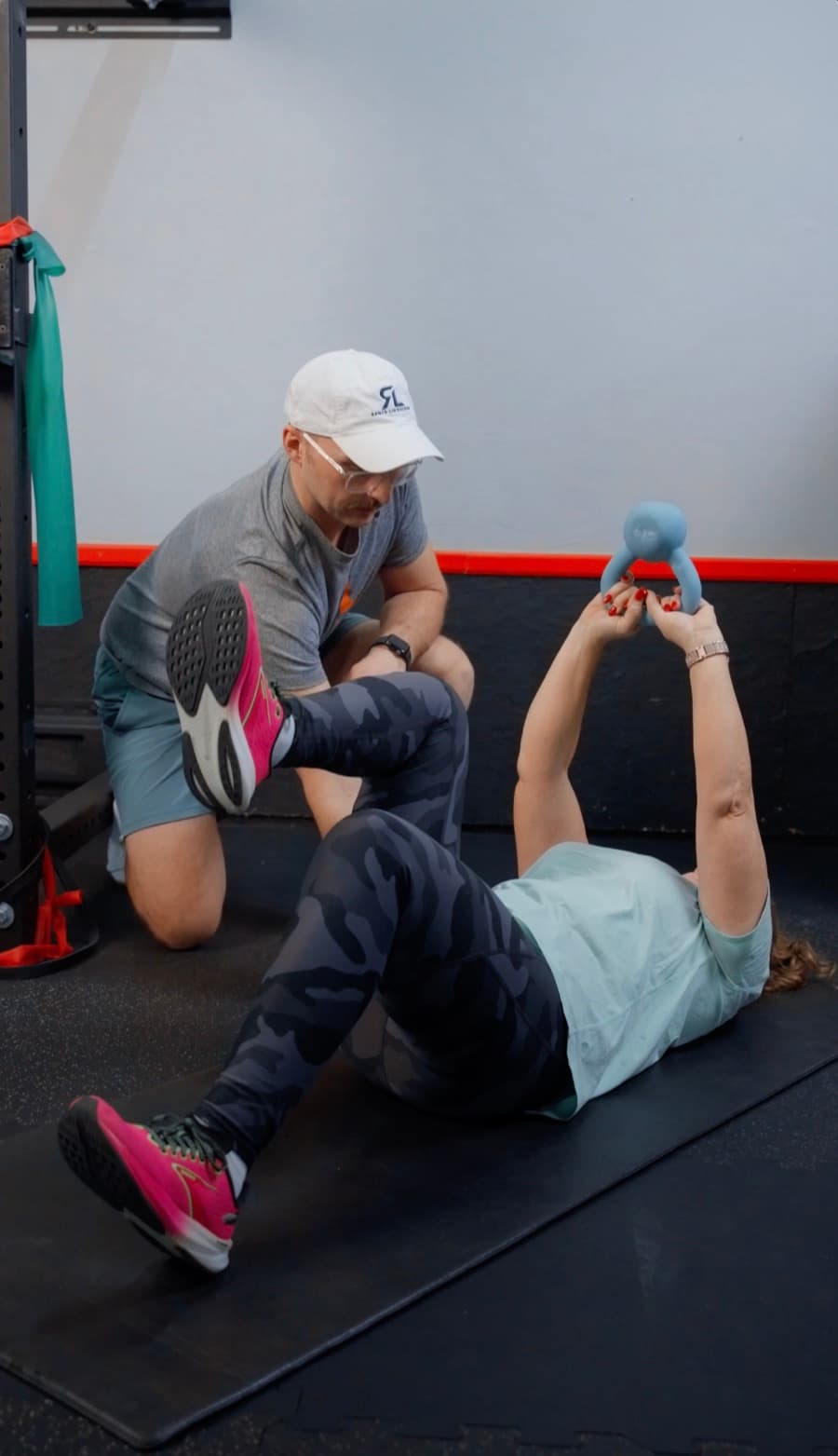
The assessment looks at the whole chain rather than the sore spot, because the sore spot is the symptom. We watch you load one leg at a time, check what the ankle and hip will actually do, and where it is useful we take objective measurements of strength and side-to-side symmetry, so the plan has a target and the return has a threshold rather than a hunch.
Treatment pairs hands-on work for the tissue that has become irritable with corrective exercise that rebuilds what was missing. If the ankle or the hip turns out to be the limiter, that is what gets the attention, even though the knee is what hurts. There is more on how we treat knee pain generally, and on why numbers beat a scan for a problem like this one, where imaging of a painful knee often comes back unremarkable. Reassuring, and completely unhelpful for deciding what to do next.
This is also the single most common complaint we see from cross country runners, which we covered in the injuries we treat every fall. You can find clinic details on our Wauwatosa page or get in touch at (414) 356-0414.
When knee pain is not runner’s knee
Patellofemoral pain has a recognisable pattern: front of the knee, gradual onset, worse with stairs, hills, and sitting for long periods. Some things do not fit that pattern and deserve an examination before anyone starts a strength program.
- A knee that locks, catches, or gives way underneath you.
- Swelling that appears quickly, particularly within hours of an injury.
- Pain that followed a specific twisting injury rather than building gradually.
- Pain on the inside or outside line of the joint rather than around the kneecap, especially with tenderness along the joint line.
- Night pain, fever, or pain that has nothing to do with activity.
Frequently asked questions
Can I keep running with runner’s knee?
Usually yes, at reduced volume and on flatter routes. Complete rest settles the symptom without fixing the cause, and it costs you strength you will need. The rule of thumb is that pain should stay low during the run and should not be worse the following morning.
Do I need new shoes or orthotics?
Sometimes they help, and they are rarely the whole answer. Footwear changes what reaches the knee, but it does not build hip control or restore ankle range. If a shoe change is the only intervention, expect the problem to return when mileage does.
How long does it take to fix?
It depends on which limiter you are dealing with, but you should see a meaningful change within two to three weeks of the right plan. Full return to previous mileage is commonly six to twelve weeks. Anyone quoting a timeline before examining you is guessing.
Is it arthritis?
Usually not, particularly in runners under forty. Arthritic knees tend to be stiff in the morning, achy at rest, and worse with prolonged standing, which is a different pattern. If the presentation does not fit patellofemoral pain, that is a reason to be examined rather than assume either one.
Should I get an MRI?
Not as a first step for typical runner’s knee. Imaging usually comes back unremarkable, which does not tell you what to change. If you have locking, giving way, rapid swelling, or a twisting injury behind it, that is a different conversation and imaging may well be warranted.
Can I keep training while fixing it?
Nearly always, with the volume and surface adjusted. We would reduce hills and speed work first, keep easy mileage that does not provoke symptoms, and add the hip and quadriceps strength work. Stopping entirely usually produces a detrained runner with the same knee.