
An X-ray or MRI answers one question very well: what does this tissue look like? That is genuinely useful, and for fractures, dislocations, and serious structural damage it is the right and necessary test. But it cannot tell you how much force your leg can produce, whether the injured side has caught up to the healthy one, or whether you are ready to sprint. Those are questions about function, and function has to be measured. That is the gap objective testing fills.
What imaging is genuinely good at
Imaging is the right tool when the question is structural. Is the bone broken? Is there a full-thickness tear? Is something in there that should not be? For red-flag presentations, including significant trauma, suspected fracture, progressive neurological symptoms, or pain that behaves in ways that do not fit a musculoskeletal pattern, imaging is not optional, and any clinic that would not refer you for it is the wrong clinic.
What imaging is not designed to do is explain most everyday aches. It is a photograph of anatomy at rest. Pain, performance, and re-injury risk are all things your body does under load, and a still image taken while you lie motionless cannot capture them.
Why the picture often does not match the pain
This is the part that surprises people. Findings that sound alarming on a report, such as disc bulges, degenerative changes, rotator cuff tears, and meniscal wear, turn up regularly in people with no pain at all, and they become more common with age in much the same way grey hair does. Large imaging studies of pain-free adults have found these changes at high rates across every decade of life.
The practical consequence is that a scan alone rarely settles what to do next. Two people can have nearly identical images and completely different problems: one is training normally and the other cannot climb stairs. The difference between them is not visible on the film. It is in how they produce and absorb force, where they are weak, and how evenly they load each side.
None of this means imaging findings are meaningless. It means a finding has to be interpreted alongside your history, your exam, and what your body can actually do, rather than treated as the diagnosis on its own.
What a force plate actually measures
A force plate is, at its simplest, a very precise scale that samples hundreds of times per second. When you stand, squat, jump, or land on it, it records how much force you produce, how fast you produce it, and how that force is divided between your left and right sides. A handheld dynamometer does something similar for a single muscle or joint, measuring peak strength directly rather than estimating it by hand.
That produces a few things a photograph cannot. It shows peak strength as a number you can compare over time. It shows the rate at which you generate force, which matters far more than raw strength for anything explosive. And it shows asymmetry, the gap between your injured side and your good side, which is where most re-injuries quietly originate.
Two different questions, two different tools
| The question you are asking | What answers it |
|---|---|
| Is something torn, broken, or structurally damaged? | Imaging (X-ray, MRI, ultrasound) |
| Why does this keep coming back? | Movement assessment and objective testing |
| Is my injured side as strong as my healthy side? | Force plate and dynamometry testing |
| Am I ready to return to my sport or my job? | Objective testing against a target |
| Is this treatment actually working? | Retesting the same measures over time |
| Do I need a specialist or surgery? | Imaging, alongside clinical exam and history |
The two are not in competition. Imaging rules things in and out. Testing tells you what to do about what is left, and when you are done.
The asymmetry problem: why “it feels fine” is not the same as ready
Pain usually resolves well before capacity does. A hamstring, a quad, or a calf can feel completely normal in daily life while still producing meaningfully less force than the other leg, and daily life is not where that gap gets exposed. The first sprint, the first hard cut, the first time you go down a flight of stairs quickly, is where it gets exposed.
Going by feel means you find that gap the hard way. Measuring it means you find it first, close it deliberately, and confirm it is closed before you load it. That is the entire argument for testing: it moves the discovery of a weak link from the field to the clinic.
It also changes what a treatment plan looks like. When a test flags a specific deficit, the plan targets it directly: corrective exercise aimed at that link, and where healing tissue needs protecting, blood flow restriction training to build strength without heavy load.
What a testing session actually looks like
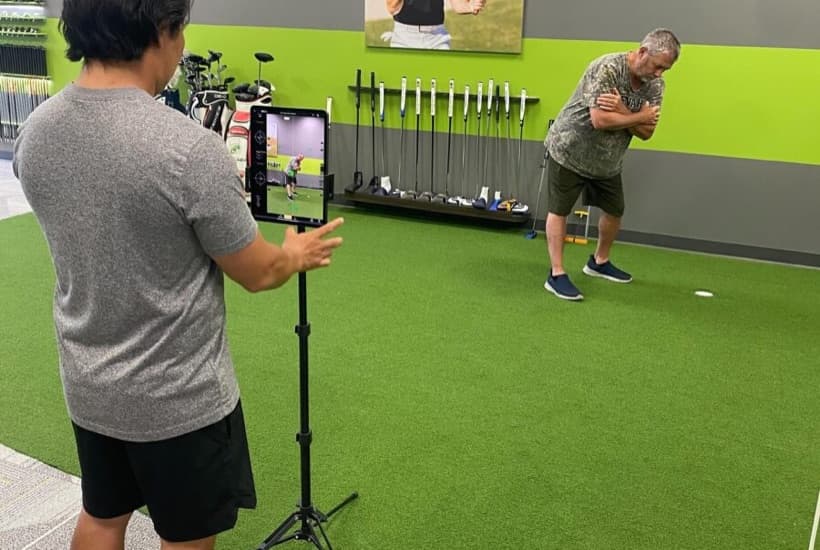
People tend to picture something clinical and intimidating. In practice it is closer to a short, structured workout. You wear normal training clothes, you warm up, and then you work through a handful of movements on the plate while it records what your body is doing underneath you.
A baseline covers three things: how much force you can produce, how evenly you produce it left to right, and how well you absorb force on the way back down. Landing matters as much as strength, because most non-contact injuries happen while decelerating rather than accelerating.
- A quiet standing measure, which shows how you distribute weight before any effort is involved. People guard an injured side long after they stop noticing it.
- A squat or press against resistance, which captures peak strength as a number rather than an impression.
- A single-leg test on each side, which is where side-to-side gaps show up most clearly.
- A jump and landing measure, where the plate reads both how much force you generate and how much you absorb.
What you get afterward is not a wall of data. It is a short read on where you actually stand, which side is behind, and what the plan will target first. If a test is beyond what your tissue can safely handle that day, we skip it and come back to it later. Nothing in the session is a fitness exam you can fail.
How we use testing at Rehab Lab
We take a baseline when you start, so there is a real starting point rather than a memory of one, and we retest at milestones using the same measures each time. You see the same numbers we do. When the numbers move, the plan is working; when they stall, the plan changes.
Testing is also how we decide you are finished. Rather than discharging you when the soreness happens to fade, we discharge you when the injured side has caught up and the numbers meet what your sport or your job actually demands. That is the standard athletes are held to before returning to play, and it is the same standard we apply to everyone else.
And when the exam or history suggests something structural, we refer you for imaging or to the appropriate specialist. Testing does not replace that. It answers the questions imaging was never built to answer. You can read more about our objective testing, see how it fits into returning from a sports injury, or read what the testing looks like inside a first visit and in the fall injuries we treat in Tosa athletes. You can also get in touch with our Wauwatosa clinic at (414) 356-0414.
Frequently asked questions
Does force plate testing hurt?
No. You are standing, squatting, pushing, or hopping on a platform, and the effort level is matched to where you are in recovery. Early on, testing may be limited to simple standing or pressing measures; the more demanding tests come later, once the tissue can handle them.
Do I need an X-ray or MRI before I come in?
Usually not. Most musculoskeletal complaints do not require imaging to begin conservative care. If your history or exam points to something structural, we will refer you for the appropriate imaging rather than guess.
Can you test me while I am still in pain?
Yes, and it is often the most useful time to do it. A baseline taken while you are symptomatic is what everything afterward gets compared against. We simply select tests you can perform safely at that stage.
My scan showed a disc bulge. Does that mean I need surgery?
Not on its own. Disc bulges are common in people with no symptoms at all, so the finding has to be interpreted alongside your symptoms and exam. Most cases respond to conservative care. Surgical opinions are warranted for specific presentations, and if yours is one of them we will say so and refer you.
Should I get imaging first or testing first?
For most mechanical problems, neither is the first step; a history and a hands-on exam is. Imaging answers what a structure looks like, and force testing answers what it can do. We order imaging when your presentation calls for it, and test when the question is capability.
Does a normal scan mean nothing is wrong?
No. Plenty of genuinely limiting problems, including weakness, poor force absorption and side-to-side asymmetry, are entirely invisible on a scan. That gap is exactly why we measure function rather than relying on imaging to explain a functional problem.