
A first visit should answer one question before it treats anything: why is this happening? Most of the appointment is spent finding that out. You will talk through the history, you will be asked to move rather than just point at the sore spot, and you will usually be treated the same day once there is a reason to treat something specific. You should leave with a plain explanation, a plan that has an end, and something to do before you come back.
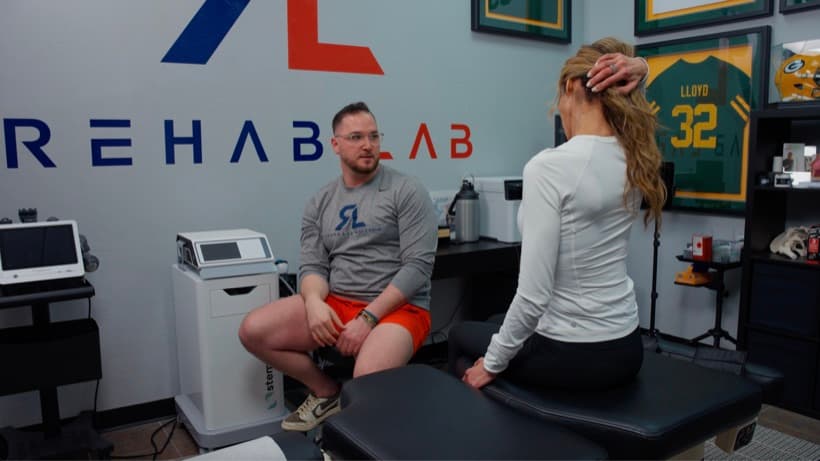
Before you arrive
Wear something you can move in. You will be asked to squat, hinge, reach overhead, and possibly walk or step, and that is difficult to assess through stiff jeans or dress clothes. If the problem involves your knee, ankle, or hip, shorts are genuinely useful.
Bring anything you already have. If you have had imaging for this problem, the report is helpful, though you do not need to chase one down before booking. If a physician or another provider has already given you a diagnosis, bring that too. It is context, not a conclusion, and it is worth having in front of us.
It is also worth thinking about your goal before you walk in, because it shapes the entire plan. Getting back to running a 10K, getting through a workday without your neck locking up, and getting back on the field by the third week of the season are three different targets with three different plans behind them.
The conversation comes first
The history is not paperwork for its own sake. What we are after is the story of the problem: when it started, what you were doing at the time, what makes it worse, what makes it better, whether it has happened before, and what it stops you from doing now. That last one matters more than most people expect, because it is how progress gets measured later.
Expect questions that seem unrelated to where it hurts. Sleep, previous injuries on the other side, an ankle you sprained years ago and forgot about, your training or work load over the last few months. Pain very often shows up downstream of the actual problem, and the history is usually where that trail starts.
Then we watch you move
This is the part that most distinguishes a movement-based clinic from a quick adjustment, and it is the part patients tend to find surprising. Instead of treating the painful spot immediately, we look at how the whole chain behaves under load: how you squat, how you hinge at the hip, how you rotate, how you load one leg at a time, and where the motion goes missing.
A stiff mid-back shows up as shoulder pain. A hip that does not rotate shows up as low back pain. An ankle that lost range years ago shows up as a knee complaint. Treating only the painful end of that chain is why the same problem keeps coming back after it briefly feels better, which is the pattern most people arrive with.
Orthopedic and neurological testing is used where the history calls for it, alongside hands-on assessment to identify which joints and tissues are actually involved. Where objective numbers are useful, we take them, so that progress later is something measured rather than remembered. Our guide on testing versus imaging explains what those numbers add.
Treatment usually starts the same day
Once there is a working explanation, treatment begins. It follows the assessment rather than replacing it, which is the whole point of doing the assessment first. Depending on what was found, that can mean adjustments to restore joint motion, hands-on soft-tissue work such as Active Release Technique, dry needling, or one of the tools we reach for when tissue needs more than hands, including shockwave therapy and Class IV laser.
What you will not get is a standard sequence applied to everyone who walks in. If the assessment does not support a particular treatment, it does not happen, and that includes the adjustment. Some presentations call for it on day one and some do not.
You leave with a plan, not a package
Before you go, you should be able to say what is wrong in your own words. If you cannot, the explanation was not good enough and it is worth asking again. You should also have a rough timeline, the milestones that mark progress, and a clear picture of what finishing looks like.
You will also leave with something to do. Recovery happens mostly outside the treatment room, and a plan that is entirely passive tends to fade between appointments. It is usually a small number of specific movements rather than a long list, because a short plan that gets done beats a comprehensive one that does not.
What you will not be asked to do is buy a long prepaid block of visits before anyone knows how you respond. A visit range is an estimate that gets revised as the numbers move, and being discharged is the goal rather than a lost customer.
What happens if we are not the right fit
Some problems belong somewhere else, and you should hear that on the first visit rather than after six weeks of care that was never going to work. If the exam or history points toward a fracture, a significant tear, a condition that needs imaging, or anything outside the scope of conservative care, we will tell you directly and point you toward the right provider.
The Froedtert and Medical College of Wisconsin campus is minutes from the clinic, and plenty of our patients are people who tried conservative care first and needed a specialist, or the reverse. Neither direction is a failure. Starting conservative is reasonable for most non-emergency musculoskeletal complaints, provided the clinic knows when to escalate.
Where to find us
The Wauwatosa clinic is at 11707 W Dearbourn Ave Ste B, on the west edge of Wauwatosa near Highway 100, and Rehab Lab was founded by Dr. Sam Wagner. You are treated by a licensed Doctor of Chiropractic for the appointment rather than handed off partway through.
If you are still deciding, our guide to choosing a sports chiropractic clinic in Wauwatosa lays out what to ask any clinic before you book. Otherwise, see the Wauwatosa clinic page for details or get in touch at (414) 356-0414.
Frequently asked questions
Will I be adjusted on the first visit?
Often, but only if the assessment supports it. Treatment on day one is common, and an adjustment is one of several options rather than the default. If your presentation calls for soft-tissue work, rehab, or a referral instead, that is what you will get.
Do I need a referral to book?
Chiropractors are licensed primary-contact providers in Wisconsin, so you can generally schedule directly without a physician referral. If your insurance plan has its own referral requirements, it is worth confirming those with them before your first visit.
What should I wear?
Clothes you can move in. Athletic wear is ideal, and shorts are helpful for anything involving the knee, hip, or ankle. You will be doing more moving than you might expect for a chiropractic appointment.
Will the first visit hurt?
Parts of the assessment may reproduce your symptoms, which is often useful information rather than a problem. Treatment is matched to what the tissue can tolerate that day. Some hands-on work is uncomfortable while it is happening, and nothing should leave you worse than you arrived.
How soon will I feel better?
Some people notice a change after the first visit and some do not, and neither tells you much on its own. What matters more is the trend across the first few weeks, which is why we take a baseline at the start and compare against it rather than relying on memory.
How long should I allow for the first appointment?
Allow around an hour. That covers the history, the movement assessment, the explanation of findings and your first treatment. Follow-up visits are shorter. Arriving a few minutes early to complete paperwork keeps the clinical time for clinical work.